
Striking a Balance: Working Fully Remote for Nearly a Decade

Recently, I was chatting with an engineer who was transitioning into a fully remote role for the first time in their career. They were excited, but also had a touch of anxiety about it. For someone who had spent their entire career in the familiar commute → office → commute loop, this was flipping that on it's head.
As someone who made that same transition nearly a decade ago, I recognized the fear immediately. It’s real, and it’s multifaceted: the loss of routine, the fear of invisibility, the quiet internal voice asking “Am I doing enough?” or “Do people even know what I’m working on?”
While this fear is real, the reward of the process can be worth it when done well — which isn’t always a guarantee. Fully remote work may not be for everyone, or every team or company, but it can truly be transformative when those stars do align.
It isn't for everyone
Remote work isn't for everyone, it just isn't.
At its core — it amplifies who you are, for better or worse. It removes the guardrails and you either thrive or…

When people find out I work remotely, the reactions are pretty telling:
"Oh it must be so nice to be able to do <chore> during the day or go spent a few hours doing <hobby>, or maybe catching up on the latest season of <popular show> on Netflix!"
Responses like that are usually a red flag, at least with regard to remote work. They frame remote work as fun or leisure – not work – and that mindset rarely ends well.
Remote work, done well, requires a few non-negotiables:
- Self-discipline - Not hustle culture or constant grind bro, but accountability. You’re responsible for your time, your focus, and building habits that let you do real work without someone looking over your shoulder.
- Responsibility - Outcomes matter more than activity. No one sees you "trying", only what you ship, unblock, or move forward.
- Communication - Silence can be ambiguous. Over-communicating is usually a kindness, and if you’re long-winded like me, slap a big tl;dr at the top for those that don't want the nitty-gritty, and move on.
- Trust - The foundation everything else sits on. Trust in yourself, trust within your team, and trust up and down the management chain. Remote work dot not function without it.
And even if you possess all of those crucial traits, that's only one piece of the puzzle because it takes two to tango.
It isn't for every company
As Jean-Luc Picard once put it: "It is possible to commit no mistakes and still lose" and the same applies to remote work.

You can be the perfect remote employee and still fail if the company or culture isn’t aligned for it. A few common fault-lines can include:
- Presence vs. Outcomes - Is the culture focused on visibility or results? When "being seen" and "getting things done" are considered equal, then remote work can struggle.
- Information Flow Disparities - When crucial information isn't properly disseminated, either in-office or remote, this can lead to division. FOMO can become a legitimate problem and employees can be left guessing (or worse, unaware that they’re missing anything at all).
- Expectations Around Availability - Is there a burning Sauron-like eye in the sky monitoring your ever movement? If stepping away from your desk triggers anxiety or follow-up pings, the system is already under strain.
- Control Masquerading as Productivity - Excessive mandatory check-ins, theaters surrounding status, and surveillance tools don’t create alignment; they create friction.
What ties all of these together is, once again, trust.
Just as remote work amplifies individuals, it amplifies organizations too, especially their relationship with trust. A lack of trust often leads to control, control breeds friction, and friction eventually burns people out (something, something dark side).
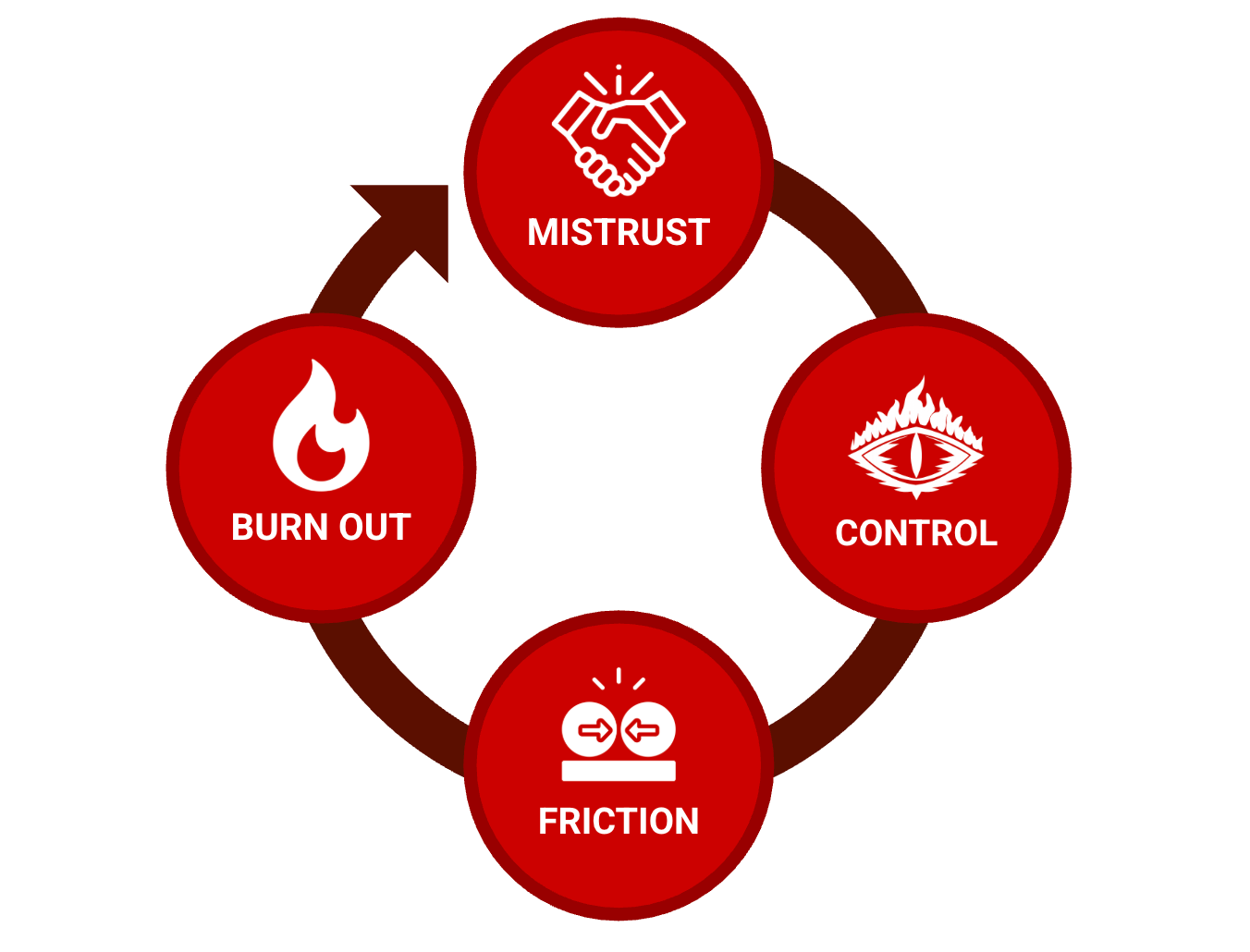
Remote work doesn’t create dysfunction — but it’s very good at revealing it. It doesn’t fail because people slack off; it fails when organizations refuse to change how they communicate and how they measure work.
You can’t control company culture. You can only control one thing: yourself.
So what can you do to make remote work actually work?
What's worked for me?
Most of the fears people have going remote are conquerable. Not instantly — but deliberately.
Drawing the Line
Without a doubt, knowing where to draw the line between work and not-work is the most important skill to develop when working remotely.
It’s a delicate balance. Let work bleed too far into home life and burnout isn’t a possibility — it’s inevitable. Let the balance tip too far the other way and… well, that problem usually sorts itself out pretty quickly.
The goal isn’t perfection — it’s having some intentional guardrails in place.
Physical Boundaries
A physical boundary helps more than most people expect. Some kind of line of demarcation that says: when I’m on this side, I’m at work; when I cross it, I’m not.

It might be a door, a staircase, a dedicated room, or hell, maybe just a line of duct tape on the floor. It sounds trivial, but it matters more than you think.
Sometimes shit happens, and these lines can blur. Trust me, I've been the person checking Slack and perusing PRs while in line at Disney. That's okay – just don't make it the expectation.
Mental Boundaries
If physical boundaries are helpful, mental ones are essential — and much harder to maintain.
This is where guilt creeps in. Where feelings of invisibility show up. Where that quiet internal voice starts asking, "Am I doing enough?".
Unfortunately, experience is the best teacher here. You have to draw on your past — remote or not — and honestly assess whether you’re delivering. You don’t need to be the best there ever was (sorry, Ash Ketchum), but you do need to be effective and reliable.
If you’re doing the work, shipping results, and communicating clearly, trust that.
Retaining Your Routine
Routine matters more in remote work than most people expect. Preserve the rituals that anchored your workday before. That commute time? It’s now yours — use it intentionally.
Try your best to ensure that most, if not all, of your work-related rituals are left intact. Have a favorite podcast that you listened to while sitting in traffic? Throw some headphones on/in and listen to it on a morning walk, or while at the gym.
You can quickly find that you can be much more intentional with many of these activities that you'd just try to "slide it if I can".
Social Distance
If work was a major source of social interaction, remote work can quietly shrink your world — and you need to be mindful of it.

Get out of the house.
Be intentionally social, even if you are an introvert. Small things help. It might be a neighborhood walk, a trip inside the coffee shop (not the drive through), or maybe a trip to the grocery store when you want a snack. You never know when you'll find really kick-ass breakfast burritos that your local convenience store sells.
Work and social life can overlap too, especially in more distributed environments. Casual virtual hangouts, no-work-talk happy hours (with cocktails), games, fantasy football leagues — whatever works for your group.
The point is connection.
Listen to your Heart
Remote work is a balancing act. Sometimes work spills into life. Sometimes life spills into work. That’s fine — just make sure those moments are the exception, not the rule.
Lean on the people around you. If your family rolls their eyes every time your phone buzzes, you might need to pull back. If your coworkers (virtually) roll their eyes every time you say "I’ll handle it," you might need to lock in, as the kids say.
It’s a balancing act. And like most things worth doing — it takes practice.